My exploration began in the lab studying how cells heal, how molecules react, and how materials can protect life. But as I continued my research, I realized that these questions weren't just about science. They were also about how we see, feel, and connect with the world.
To me, science and art are two different languages exploring the same truth. The scientific way of understanding and the artistic way of feeling both move toward the same place. The more I understand the principles of science, the more I learn how to connect deeply with the world. I want to express my scientific imagination through emotion and keep walking along the boundary where both worlds meet.
As Leonardo da Vinci saw knowledge as the harmony between reason and wonder, I hope to explore truth through science and express it through design, a language that can be felt.
“How Museum Design Shapes Public Understanding: A Comparative Study of the Penn Museum and the Mütter Museum.”
Jun 2025– Oct 2025
Museums are not merely the final resting places of artifacts; they are dynamic, interpretive environments where spatial design and curatorial decisions shape how audiences perceive the objects on display. Comparing institutions with similar missions and collections illuminates the effectiveness of their strategies for communicating specialized knowledge to the public.This paper compares two notable museums in Philadelphia—the Penn Museum and the Mütter Museum—both of which are affiliated with major educational institutions: the University of Pennsylvania and the College of Physicians of Philadelphia, respectively. The Penn Museum is an archaeological and anthropological museum, while the Mütter Museum focuses on medical history. Each grapples with ethical questions surrounding the display of culturally sensitive materials and human remains. Despite their disciplinary differences, both institutions seek to translate academic research into accessible, meaningful experiences for diverse audiences.By analyzing the digital interfaces, architectural layouts, and visitor experiences of both museums, this paper explores how design strategies influence public interpretation of their collections. The study draws upon John Howard Falk’s Contextual Model of Learning, which understands museum learning as an interaction among personal, sociocultural, and physical contexts. Through this framework, the comparison highlights how each museum’s design mediates between expert knowledge and public understanding.Ultimately, this comparative analysis reveals that the museums’ respective approaches to exhibition design and spatial storytelling reflect broader ethical and pedagogical questions about accessibility, interpretation, and the role of design in shaping public engagement with knowledge.
This paper examines the evolution of Japanese beauty ideals, beginning with the Edo period’s elaborate aesthetics and continuing through the Western influences of the Meiji era, the emergence of the “Modern Girl” in the Taisho period, and the complex interplay between modernity and tradition in the Showa and Heisei periods. Exploring how these standards have been influenced by factors such as social hierarchy, gender roles, and global trends allows us to gain a deeper understanding of Japan’s cultural history and the way beauty has been used to express identity, status, and societal values. This paper aims to focus on the various ways in which beauty standards in Japan have both resisted and embraced change. It offers insights into the broader cultural forces that have shaped them. It not only provides a historical overview but also raises questions about the ongoing influences of these standards in contemporary Japanese society.


This study examined whether the macrophage receptor MARCO recognizes components of Streptococcus pneumoniae.
Using NF-κB signaling assays, researchers found that MARCO does not bind to non-protein cell wall elements such as peptidoglycan or lipoteichoic acid.
The results suggest that MARCO’s native ligand is a surface protein on the bacterium.


“Treatment Methods for Severe Burns Using MXene and Bandage Microstructural Patterns.”
Jun 2023–Jan 2024
This study explored an efficient treatment method for severe burn patients by using MXene-based materials to prevent infection and promote skin regeneration. Through experiments on tile pattern formation, researchers identified the optimal microstructure design for bandages to maximize healing efficiency. The findings suggest potential applications of this microstructured surface design beyond burn treatment to various medical contact surfaces.


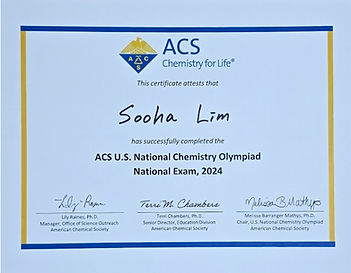
USNCO
US National Chemistry Olympiad National Exam Nominee. Was selected as one of three state representatives.